,

I saw a new heaven and a new earth. (Rev.21:1)

The older we get, the smaller we get, not just literally but most often also figuratively.  Usually, as people get older, they go bent through life.  But it is a well-known phenomenon that with the increasing years, youthful overconfidence and pride also gradually disappear.  Maybe that is one of the reasons why people have to become so old these days.  We realize how little we are, and we become modest, finally…

Just as familiar is the phenomenon that old people, more than ever before in their lives, become religious.  Goethe once expressed this with the following words:

In youth: idealist.

As an adult: realist.

As a greybeard: mystic.

That too is a feature of becoming old: our hands become quiet.  We turn inward and fold our hands in prayer.  And in the silence of our little inner world a great world begins to sound.  We need not wait with this until we have become old and bent.  Every moment in our life gives us the opportunity to learn, to fold our hands in prayer.  In this gesture, the germ of the future creation is hiding, just as in the bud of a plant the flower is hiding.

This future creation, the New Jerusalem, is not only bestowed on us as a new heaven that descends down to us, but also as a new earth, which we ourselves have collaborated to build.

With our helping, healing, praying hands, we assist in silence to build a new heaven and a new earth.


-Rev. Bastiaan Baan, November 23, 2025

,

“You have the name of being alive, yet you are dead.” (Rev.3:1)

When you really want to understand someone, you have to be willing to reverse roles with him or her.  Usually we look at things from our own standpoint, our own opinion.  We owe these to our closed personality, which has become a distant spectator of the world: I think… I feel… My opinion…  With all our opinions, we also lose connection with the world the way it presents itself to us.  One could say: if people didn’t have so many opinions, they would discover much more.

Imagine that the roles are reversed.  We are more or less blind to reality.  I do not see the world, but the world sees me.  I do not know the spiritual world, but the spiritual world knows me—better than I know myself.  Christ sees me; I cannot hide from Him.  He knows me inside out.

What does He see when He looks at me?  “You have the name of being alive, yet you are dead.”  That is the depressing reality of a spiritual world that sees us and sees right through us.  We act as if we stand in the midst of life, but before the countenance of God we are “the living dead.”

When you begin to live with the Act of Consecration, eventually you cannot remain a distant spectator anymore.  The roles are reversed.  Like the blind, we feel our way to the spiritual world.  But Christ, He sees us, with all our strayings, denials, weaknesses.  And in spite of that—or perhaps precisely because He sees us and knows us—He gives Himself to each of us.

Though I am blind, though I am as dead,

He cares about me.

Take me as You have given Yourself to me.


-Rev. Bastiaan Baan, November 9, 2025

,

“Stand fast, girded about the loins with truth. (Ephesians 6:14)

When in our language we can’t find the right words to express something, we use gestures to reinforce our words.  Sometimes such a gesture says more than all words.  Of all the gestures we are familiar with, beckoning is perhaps the one that leaves you most free.  Everyone can do with it what they want.  You can follow it or just let it be.

Our time spirit, Michael, beckons us.  He does no more and no less than making this eloquent, tacit gesture.  If he did more, he would probably overwhelm us.  “Every angel is terrifying,” wrote Rilke, the poet.  If he gave us less than a beckoning, even a wise person would probably not recognize him.

When you try to picture this taciturn, beckoning archangel, you will recognize in the Act of Consecration at this time of the year another eloquent gesture.  It sounds simple: Michael stands.  These words sound five times in the epistle and insert during Michaelmas time.  “He who stood … He who stands …”  Between fight and flight, between offense and defense, he has taken a place where he remains standing—whatever happens.

That is also what the apostle Paul wants to tell us when he calls on us—no to fight, but to “resist the well-aimed attacks of the Adversary.”  Not to rush forward or to shrink back, but to stand, “girded about the loins with truth, with the breastplate of righteousness, the feet shod with preparedness to spread the message of peace that comes from the angels.”


-Rev. Bastiaan Baan, October 26, 2025

, ,

The Epistle of the Trinity

With the day of the Archangel Michael on September 29, a weeks-long hushed period comes to an end, a time without highlights, seemingly standing still between the great festivals of St. John and Michael.  Those who have experienced these ten weeks at the altar will be impressed with the always returning prayer to the Trinity.  Although this epistle disappears and is, in a certain sense, overwhelmed by the appeal to Michael, it also resounds, barely audibly, like under- and over-tones in music.  In due time, these words become the undercurrent of all our religious life.  It is as if the words of this epistle want to say:

Whatever may happen:

I am there.

I shall be there.

Always shall I be there.


Whatever befalls you,

In good and bad fortune,

In joy and sorrow,

Your life is My creating life.


No matter how dark the future will be,

Stronger than all darkness that will lame you

Is the light of the Spirit

That shines on everything and everyone.


That is the silent, strong undercurrent of infinite trust of God in human beings, which is with us always, from the cradle to the grave,

All our life,

All our lives.


-Rev. Bastiaan Baan, September 28, 2025

,

Healing Ten Lepers (Luke 17:11-19)

The healing of the ten lepers in the Gospel of Luke is not only an example of divine power, but also of human weakness.  The tragedy, the disillusionment sound in the question Christ asks when only one returns to thank Him: “Were not ten healed?  Where are the other nine?  Are they not returning to praise the power of God?  Why is it only this foreigner who does that?”  To none of these questions does He get an answer.

We only need to briefly project ourselves into the situation to feel the painful rejection Christ had to undergo.  Almighty as His healing power may be, so powerless does He stand vis-à-vis people who turn their backs on Him and simply disappear.

That is how it went at the time.  And now?  Does history repeat itself—or do we perhaps do it differently than at that time?

We are all suffering from a collective illness that has estranged us from our divine origin.  Think of what the Act of Consecration calls the sickness of sin.  Even more concrete is the expression Rudolf Steiner used for the sickness of our time.  He called it: der Aussatz des Materialismus, “the leprosy of materialism.”  This sickness is unavoidable; we are all infected by it.  The only medicine is:  the healing medicine, His body and blood.  And when we receive this sacrament, what is then our answer?  Do we return to thank Him?

He does not want to give us His meal—He wants to share it with us.  Sharing begins with thanking.  Then only does this meal become complete, if it becomes eu-charist of Him and of us, which means: giving thanks.  Then only can He say, just as to the one person who thanked Him: “Your faith has made you whole.”


-Rev. Bastiaan Baan, September 14, 2025

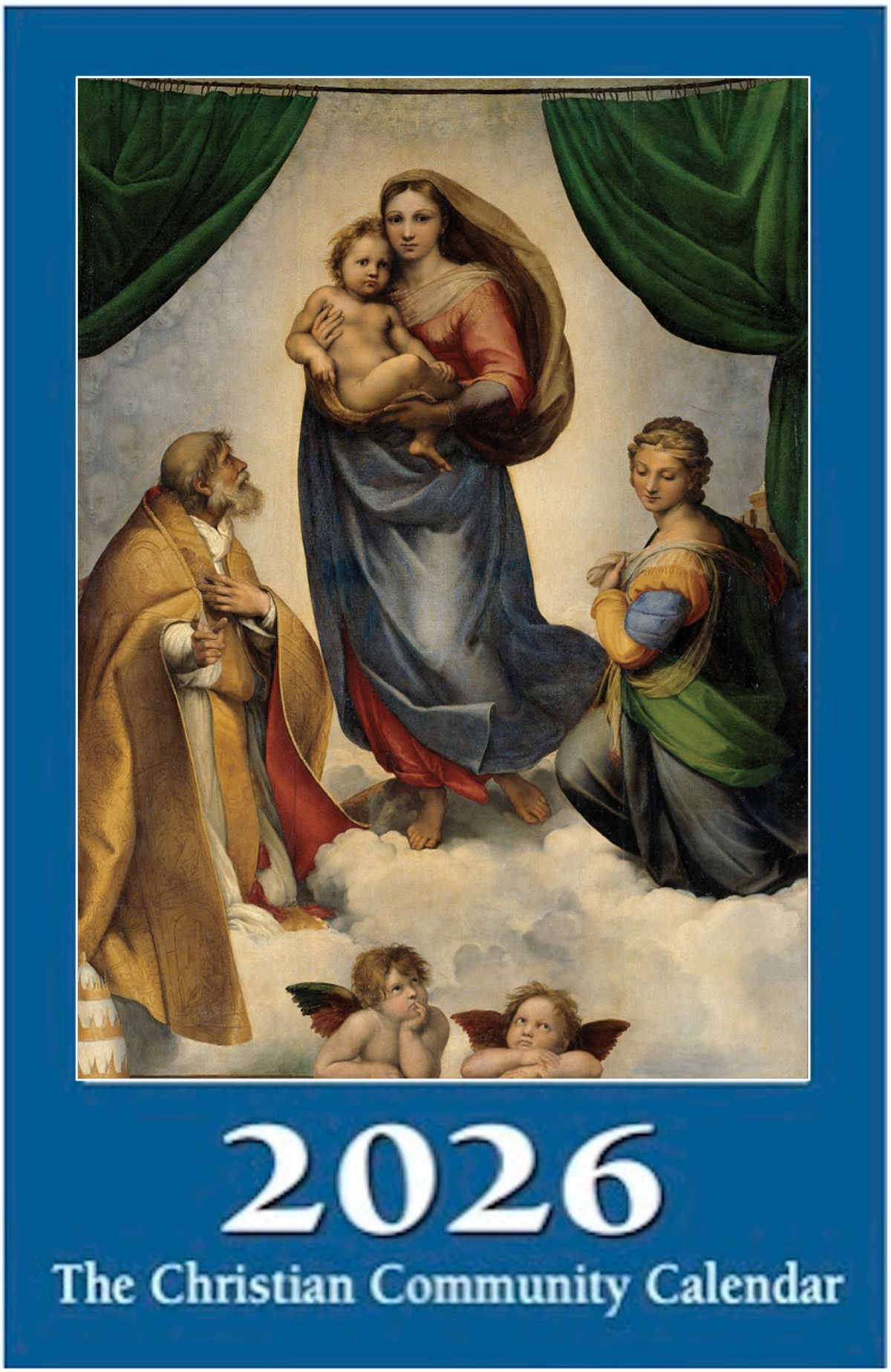
Holiday Calendars!


Time to order your 2026 Christian Community calendar. The calendar includes the festivals of the year the Gospel Readings of the week, the list of priests and their congregation and more. 2026 Christian Community calendar artwork is devoted to Rafael.

Wall Calendars – $35

Pocket Calendars – $15

To order, email Nora Minassian at noraminassian@me.com or call 240-381-8557

,

“And He took him aside by himself, away from the crowd… (Mark 7:33)

The Dutch language has the word eigenwijs which, literally translated, would be something like “own-wise,” and is used for someone who is out of step with others, or sees things differently from the way others normally view them.  Formerly, someone who was “own-wise” was just annoying.  When decisions had to be taken in a group, such a person was soon considered to be a spoilsport who had to be isolated.  Today the word has developed a different meaning.  It is even encouraged: do it in your own way, don’t let others tell you what you should say or do.  For we have all become more or less closed personalities, each one with our own opinions, our own wise.

But this individuality is as a double-edged sword.  On the one hand, it makes us autonomous, frees us from ties; on the other, it brings us into a world of colliding interests, opinions, and conflicts.  If we only follow our own wisdom, our conversations become like verbal combat among the deaf, who are all locked up in their own points.

To heal a deaf person, Christ had to take him away from the crowd to a quiet place.  There, alone with him, He could perform the miracle of the healing and open his ears.

Also our deafness, our own wisdom that is estranged from divine wisdom, can only be healed when we are in silence together with Him.

That is the way and the significance of the Act of Consecration—being together with Him in silence.  Where in the world can you still find such a spot, where you can practice the art of listening with full attention?  For, the art of prayer is nothing other than the art of listening to the will of God.  The Act of Consecration teaches us to lead a listening life.  Sooner or later, He will open our ears to His presence, not only at the altar, but in every human being, no matter how “own-wise” we may be.

-Rev. Bastiaan Baan, August 31, 2025

, ,

“Ask, and it will be given you.” (Matthew 7:7)

If things were as simple as it sounds in this sentence, all our questions would be answered and all our desires fulfilled.  But the reality of life is very different.  How often have we asked the spiritual world a question, fervently prayed for help—and no answer ever came.

But did we ask the right question?  Or did we perhaps not hear the answer because we were expecting something very different?

We have in our world, which always focuses on outer results, lost the knack of asking questions.  Even worse, it has often become a caricature.  The spiritual world does not take to cheap questions, and even less to cheap answers.  Real questions need time to be born.  To ask a real, honest question, you have to nurture it, brood on it, until it has ripened.  For, everything we ask of the divine world is subject to the plea: Not my will, but Your will be done.

It makes no sense to ask to be spared illness, suffering, and evil.  Prayer is no means against evil, but a means to make the best of even the worst that happens to us.  In every human life there will come temptations that threaten to exceed our forces.  There are not only things like ordeals to test us, enlighten us, and initiate us, but there is also darkening, and failed initiation.

But when the hardest ordeal comes, when you think: I can’t do it anymore—remember then the plea of Christ during His greatest temptation:

“Father, if it be your will, then let me be spared this cup.

But not my will but your will be done.” (Luke 22:42)

No human being stood by Him.
He was not spared suffering.
But an angel strengthened Him.


-Rev. Bastiaan Baan, August 4, 2025

, ,

“You are the Christ” (Mark 8:29)

Long ago, there was a time when it was necessary not just to recognize Christ in silence, but to also confess Him emphatically, as Peter was the first to do: “You are the Christ.”  Of course, because at that time there was almost no one who recognized the Son of God, Christ, in the Son of Man, Jesus.  In our time you cannot just pronounce that.  When you loudly start proclaiming that He is the Christ, no one wants to hear it.  On the contrary, you then just irritate others, or your words are blown away in the wind.

Confessing Christ—how do you do that in our world?

Actually, we constantly confess something without words as we go through the world.  Just look at the faces of the people around you: so much somberness, so much sorrow, so much annoyance, so much anger.  Just look at yourself when you are walking through the streets of a city.  Without sensing it ourselves, we spread and confess our moods, for our face, our posture, our footsteps speak volumes.  We leave our tracks non-stop, visible and invisible.  In the world in which we are living these days you don’t need to pronounce what you know and believe; without speaking a word, you can DO what you know and believe.

When we receive His peace at the altar, this gift can become our confession.  This peace is not only meant for us, but through us for the world.  That is the appeal of Christ after He has bestowed His peace on us: My peace is not of this world.  My peace wants to work in the world through you.  Are you ready to confess my peace?

Give me your hands, your head, your heart, your feet – and walk the way of peace with me.

– Rev. Bastiaan Baan, July 27, 2025

, ,

Peace

Wherever you look around you, in our time peace has become a shaky, unstable concept, both at large in our society, and also in relationships between people.

Hardly has peace been established somewhere, and it is broken again and superseded by chaos and fighting. Even in the individual peace is often elusive—hardly has our inner life been set at rest, and the storm of our changeable moods breaks out again. In nature it is similar. A peaceful landscape can suddenly be drowned in violent rain, or wither in the scorching heat of the sun. Nature holds up a mirror to us of our chaotic, disturbed world. In brief, nothing is as vulnerable today as peace.

The peace that emanates from Christ is beyond compare with our earthly concepts and ideas: “I leave you the peace: my peace I give to you. I do not give as the world gives.” (John 14:27) When we make an effort to comprehend what we receive with this form of peace, our intellect has to capitulate. What does Christ bestow on us when we for a moment feel His touch with the words: “The peace be with you”? From His suffering, from His death, and from the underworld, He has wrested a substance of peace He always bears with Him, until the end of the world. He is the calm in the storm, the quiet in the chaos, the rise in the decline.

Even if our whole life long we are not able to understand what He bestows on us with this touch, one day we will stand face to face to Him, and He will remind us of what He gave us:
“I leave you the peace: my peace I give to you. I do not give as the world gives.”

– Rev. Bastiaan Baan, June 10, 2025